
NIS2 Directive: A Guide to Physical Data Security to Avoid Penalties

NIS2 Directive: Why Physical Data Security is Crucial to Avoid Penalties
In the current landscape of digital transition, cybersecurity has become the absolute priority for Public Administrations and the private sector. At the center of this regulatory revolution is the NIS2 Directive (EU 2022/2555), the new foundation of cyber resilience in Europe.
However, when companies plan their defenses, they tend to focus exclusively on digital barries: firewalls, encryption, antivirus and software updates. A serious mistake is often made by forgetting that the protection of information begins and ends with its physical destruction.
In this in-depth article, we will analyze the impact of the NIS2 regulation and discover why adopting professional document shredders and degaussers is a mandatory step to ensure full compliance and avoid millionaire fines.
What is the NIS2 Directive and which companies are involved?
The NIS2 directive establishes a high and uniform standard of cybersecurity within the European Union. unlike the previous legislation, its scope has been drastically expanded, overcoming the company size criterion to include numerous sectors deemed critical to the economy and society.
Organizations are now classified into two main categories:
• Essential Entities: Including energy, transport, digital infrastructure, healthcare, banking and Public Administrations.
• Important Entities: Comprising waste management, postal services, manufacturing, food, chemicals and digital service providers.
Attention to SMEs (Supply Chain Security): Even if your company does not fall directly into these categories, you might be affected indirectly. If your provide services (IT, logistics, maintenance) to an "Essential Entity", NIS2 requires you to meet strict security standards to protect the entire supply chain.
Article 21: There is no Logical Security without Physical Security
Article 21 of NIS2 requires the implementation of technical, organizational and operational measures that are "proporzionate to the risk". Among the fundamental requirements are:
1. Secure management of IT assets and data.
2. Protection and control of the supply chain, including the decommissioning of physical media.
3. Cyber hygiene and continuous staff training on the handling of sensitive information.
It is in this phase of Data Lifecycle Management that the boundary between logical and physical disappears. A database protected by the best 256-bit encryption loses all its value if the hard drive hosing it is disposed of without being sanitized first.
Document Shredders: The barrier against paper-based Data Breaches
Despite the digital age, paper remaing one of the leading causes of data breaches. Notes with credentials, industrial projects, medical records and printed financial statements are goldmines for malicious actors.
NIS2 imposes total control over information flows. The use of a professional document shredder - certifies according to the DIN 66399 standard (with recommended security levels from P-4 to P-7 for confidential data) - offers three strategic advantages:
• Prevention of "Trash Diving": Physically prevents the theft of corporate information from bins or disposal areas.
• Traceability and automation: Integrates the secure disposal of paper into daily processes, limiting human error.
• Guaranteed Accountability: Allows you to prove to auditors that you have and apply strict procedures for the destruction of sensitive material.
Degausser: The definitive elimination for magnetic media
What to do with decommissioned servers, broken hard drives, or computers to be replaced? Many companies believe that formatting is enough, but logically deleted data can easily be recovered with software widely available on the market.
The degausser is the definitive technological response required by NIS2 compliance for magnetic media (Hard Disk Drives, LTO tapes, floppy disks).
• How does it work? The device generates a very high-intensity magnetic field that resets the polarity of the media. The result is the irreversible destruction of 100% of the data and the hardware unusability of the disk itself.
• The advantage for NIS2: It allows the sanitization of storage within the company perimeter. Media are rendered harmless before even being entrusted to third-party companies for WEEE disposal, zeroing the risk of data theft during logistics and transport.
The Cost of Non-Compliance: Penalties and Responsibilities
Underestimating physical security in the NIS2 era is an unacceptable risk. Legislators have introduced administrative fines comparable to those of the GDPR:
• For Essential Entities: Fines up to 10 million euros, or 2% of the total worldwide annual turnover (whichever is higher).
• For Important Entities: Fines up to 7 million euros, or 1.4% of the total worldwide annual turnover (whichever is higher).
In addition, the directive establishes the direct responsibility of management bodies. In the event of serious or repeated negligence, CEOs and Board members can face temporary suspension from their managerial functions.
Your Checklist for Physical Compliance (NIS2)
To ensure that your organization is truly resilient and ready for NIS2, we recommend following these 4 operational steps:
1. Map your assets: Accurately identify where data is stored (paper archives, server rooms, PC workstations).
2. Create secure collection points: Place professional document shredders in the most critical offices (Human Resources, Research & Development, Administration, Management).
3. Update the IT procedure: Make it mandatory for any magnetic memory to pass through the degausser before it physically leaves the company.
4. Train your team: Educate employees on a golden rule: company data that is no longer needed must never be simply "thrown away," but must be physically destroyed.
Related posts

Transition to New Sustainable Packaging for FARGO Consumables

Evolis Agilia: Total color control for high-definition badge printing

UNI/PdR 125 Gender Equality Certification
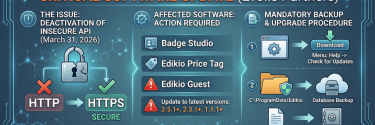
Mandatory security update for Evolis software (March 2026)
Ermes and Evolis: Over 20 Years of Excellence and Clarity in the Distribution Channel

Primacy 2 Special Edition 25

ID-ALL TradeIN-UP 2025

Entrust TradeIN 2025

Entrust Sigma DSE

0 comment(s)